
Operational Truth Over Static Requirements: Bridging Engineering Intent and Field Execution with Axiom RMS
Static requirements sit as inert text. Learn how Axiom RMS turns engineering standards into governed, executable rules that reach the field.
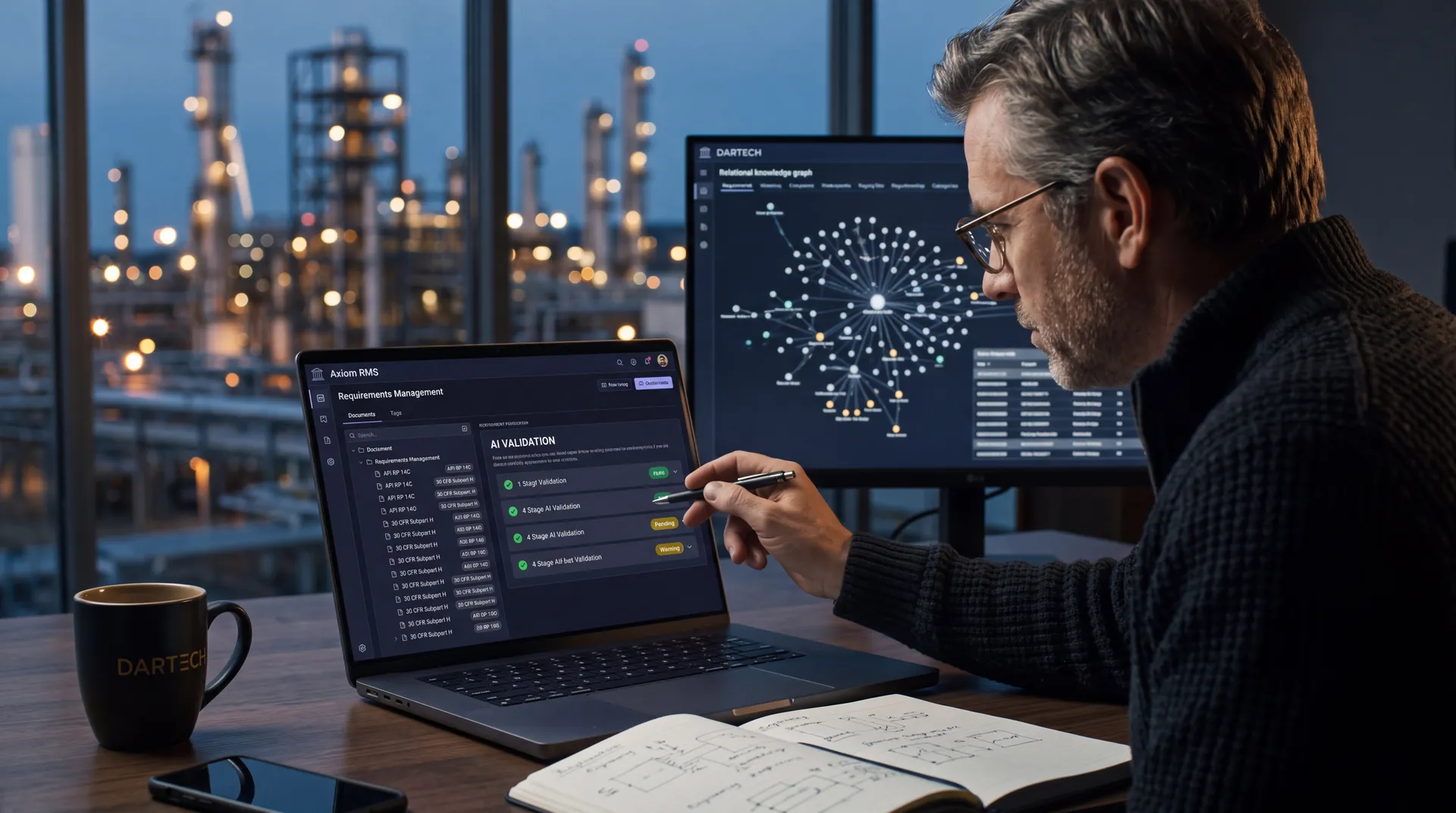
Operational Truth Over Static Requirements: Bridging Engineering Intent and Field Execution with Axiom RMS
In high-consequence industrial operations—deepwater exploration, upstream hydrocarbon production, petrochemical refining, and midstream pipeline transport—execution consistency is an imperative for survival. When market conditions fluctuate, capital margins compress, and operating environments become increasingly unforgiving, the critical operational threat facing asset owners is rarely a shortage of engineering expertise or regulatory documentation. The vulnerability lies in the structural divide between what corporate engineering mandates in specifications and what frontline teams execute on the asset.
Across capital projects and operating facilities, engineering standards, safety baselines, and statutory mandates are fragmented across static databases, legacy repositories, decentralized specification sheets, and disconnected standard operating procedures (SOPs). Over recent decades, organizations attempted to resolve documentation chaos by migrating paper libraries into relational databases, document management platforms, and digital file repositories.
However, storing a technical requirement as a static row in a database or an unlinked PDF does not make it operationally accessible. Static requirements sit as inert text. They lack operational context, cannot validate their own relevance against live facility configurations, and do not connect directly to the applications that field personnel rely on to run critical operations.
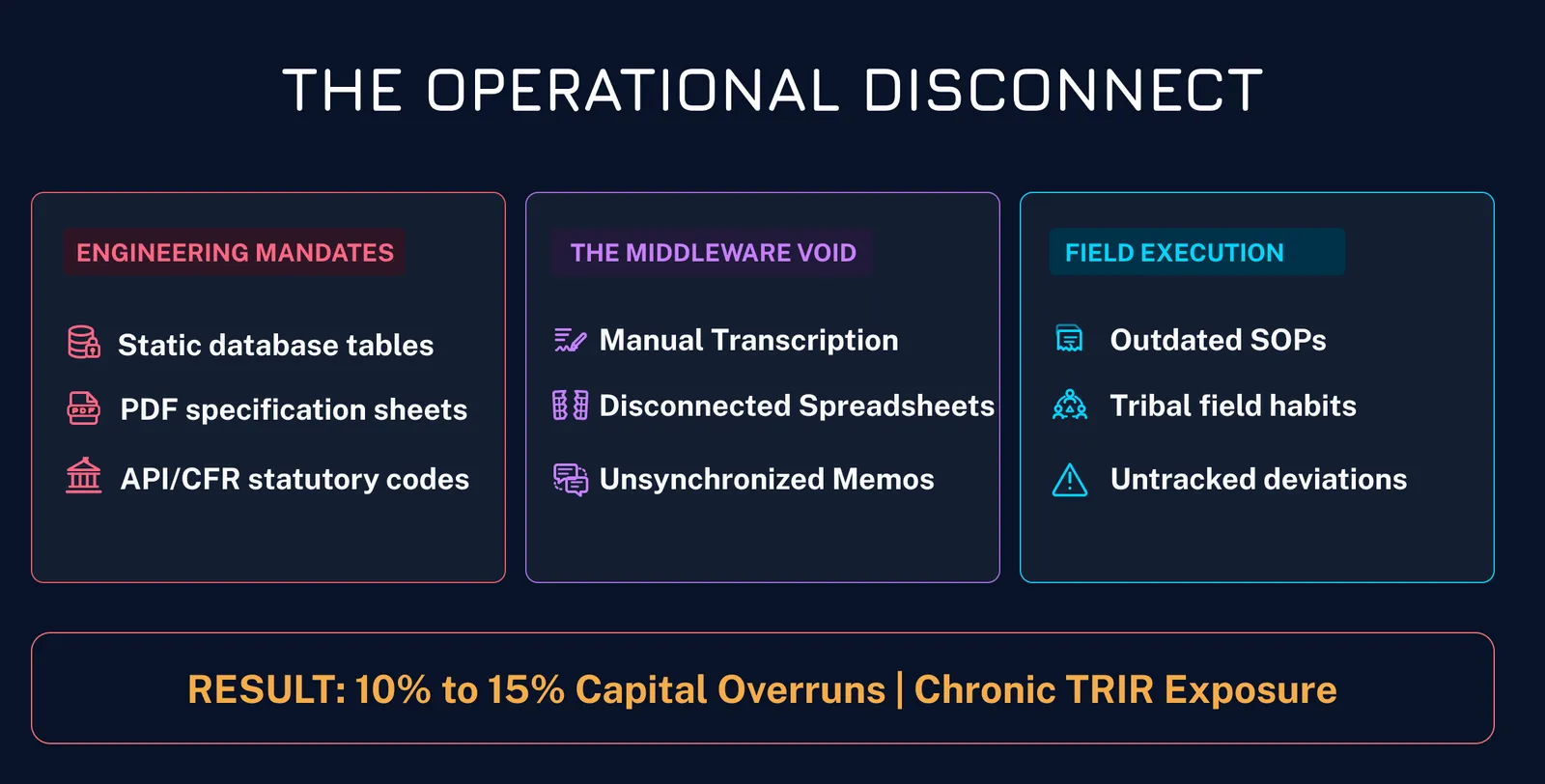
When technical requirements remain static records rather than living operational rules, performance breaks down across the asset lifecycle:
- Capital Cost Overruns: Outdated specification sheets, cross-discipline engineering clashes, and scope creep drive 10% to 15% of cost overruns on major industrial capital projects.
- Safety Degradation: Unmanaged procedural drift during maintenance turnarounds and routine operations increases Total Recordable Incident Rate (TRIR) exposure.
- Audit and Compliance Burdens: Verifying operational compliance across multi-jurisdictional mandates consumes weeks of manual cross-referencing and data collection.
- Enterprise AI Vulnerabilities: Generative and predictive AI models querying uncurated data repositories hallucinate contradictory advice and reference obsolete standards, introducing severe operational hazards.
The Axiom Requirement Management System (RMS) addresses this breakdown at its root. Operating as the enterprise Single Source of Truth (SSOT) and governance backbone of DARTECH's Axiom platform, RMS transforms passive specifications trapped in static databases and documents into structured, semantically validated, and digitally executable operational rules.
1. The Cost of Static Requirements: Beyond the Document Archive
Enterprises operate under hundreds of thousands of engineering requirements, equipment design parameters, and Health, Safety, and Environment (HSE) protocols. Yet, traditional software stacks treat requirements as historical artifacts rather than active operational constraints.
"We spent years watching incredibly talented teams lose hours every day just trying to piece together the ground truth. The data was always there, but the connective tissue was completely missing. You can't solve a fragmentation problem by throwing more fragmented tools at it."
Anmar Nazhan, Co-Founder, DARTECH
To understand why operational integrity degrades, one must evaluate the systems engineering landscape. Traditional systems engineering platforms—such as IBM DOORS, Siemens Polarion, or Jama Connect—were architected around aerospace, defense, and software development methodologies. They excel at capturing functional design baselines and managing static traceability matrices during initial asset design.
However, they were never designed to interact with live field operations, facility turnaround crews, industrial control networks, or mobile work execution suites. They treat a requirement as an immutable line item archived in a design repository.
Enterprise Resource Planning (ERP) suites and Enterprise Asset Management (EAM) platforms track procurement, spare parts inventory, work order states, and financial transactions, but they lack operational engineering context. An ERP system records when a pump was purchased or when a work order was closed; it cannot determine whether the work executed complied with API RP 14C safety containment criteria.
Because legacy databases and ERPs fail to bridge this divide, frontline teams bridge the gap with informal workarounds: uncontrolled spreadsheets, desktop file folders, and verbal handoffs.
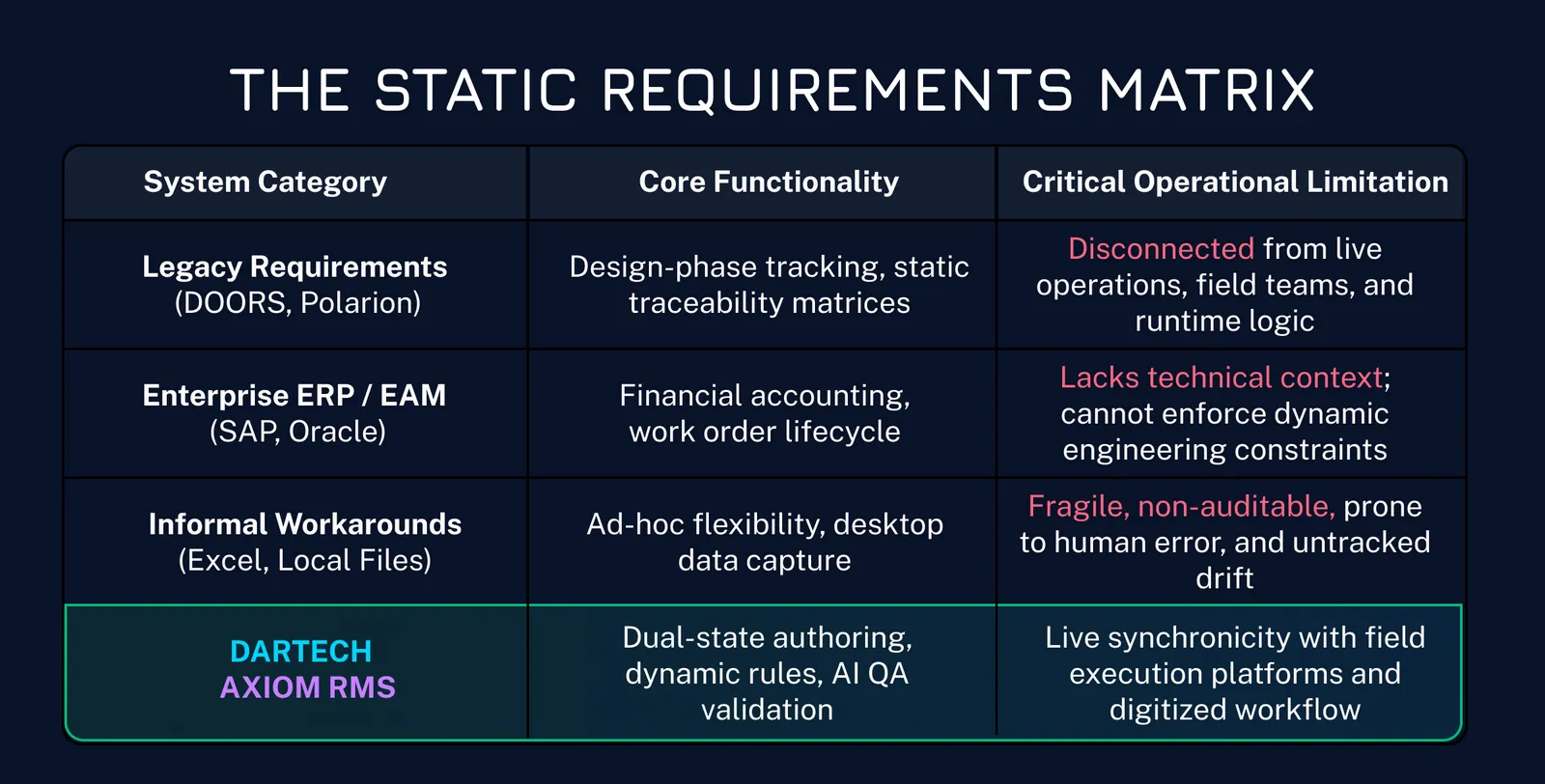
This reliance on static requirements causes four systemic failure modes across industrial enterprises:
The Translation Tax and Logic Lag
When a corporate Technical Authority updates a process safety standard—such as adjusting the testing frequency or pressure threshold of a relief valve—that revision begins as plain text within an updated database record or PDF memo. For that change to impact field operations, human coordinators must manually transcribe the prose into maintenance systems, distributed control systems (DCS), and field work packages.
This manual transcription process introduces human error and creates months of logic lag, leaving operating assets running against obsolete or conflicting guidelines.
Engineering Change Order (ECO) Proliferation
On major energy and infrastructure capital projects, design specifications span multiple engineering disciplines: civil, structural, mechanical, electrical, and instrumentation. When specifications remain static across separate Engineering, Procurement, and Construction (EPC) contractor databases, requirements diverge.
Cross-discipline contradictions that remain undetected during engineering reviews surface during module fabrication, pipefitting, or pre-commissioning. Resolving an engineering conflict during physical construction requires an Engineering Change Order (ECO), causing compounding schedule delays and inflating capital project expenditures.
Frontline Procedural Drift
Technicians, drillers, and plant operators face operational demands to maintain throughput and minimize downtime. When engineering standards are buried in unwieldy databases or static manuals, crews rely on memory or informal site conventions.
This drift between approved engineering requirements and daily execution compromises Safety Critical Elements (SCE). Isolation sequences, torque parameters, and pressure testing thresholds are missed, increasing TRIR and exposing facilities to major process hazards.
Audit Paralysis and Compliance Burden
When regulatory bodies like the Bureau of Safety and Environmental Enforcement (BSEE), OSHA, the EPA, or state agencies such as the Texas Railroad Commission (RRC) and CalGEM initiate compliance reviews, verifying adherence requires manual document retrieval.
Engineers and compliance personnel spend weeks matching database records with signed field tickets, paper logs, and work permits. The process strains technical resources, inflates compliance overhead, and exposes the organization to audit findings caused by obsolete documentation.
2. Dual-State Digitization: Transforming Engineering Text into Executable Logic
The core architectural innovation of the Axiom Requirement Management System is its dual-state representation.
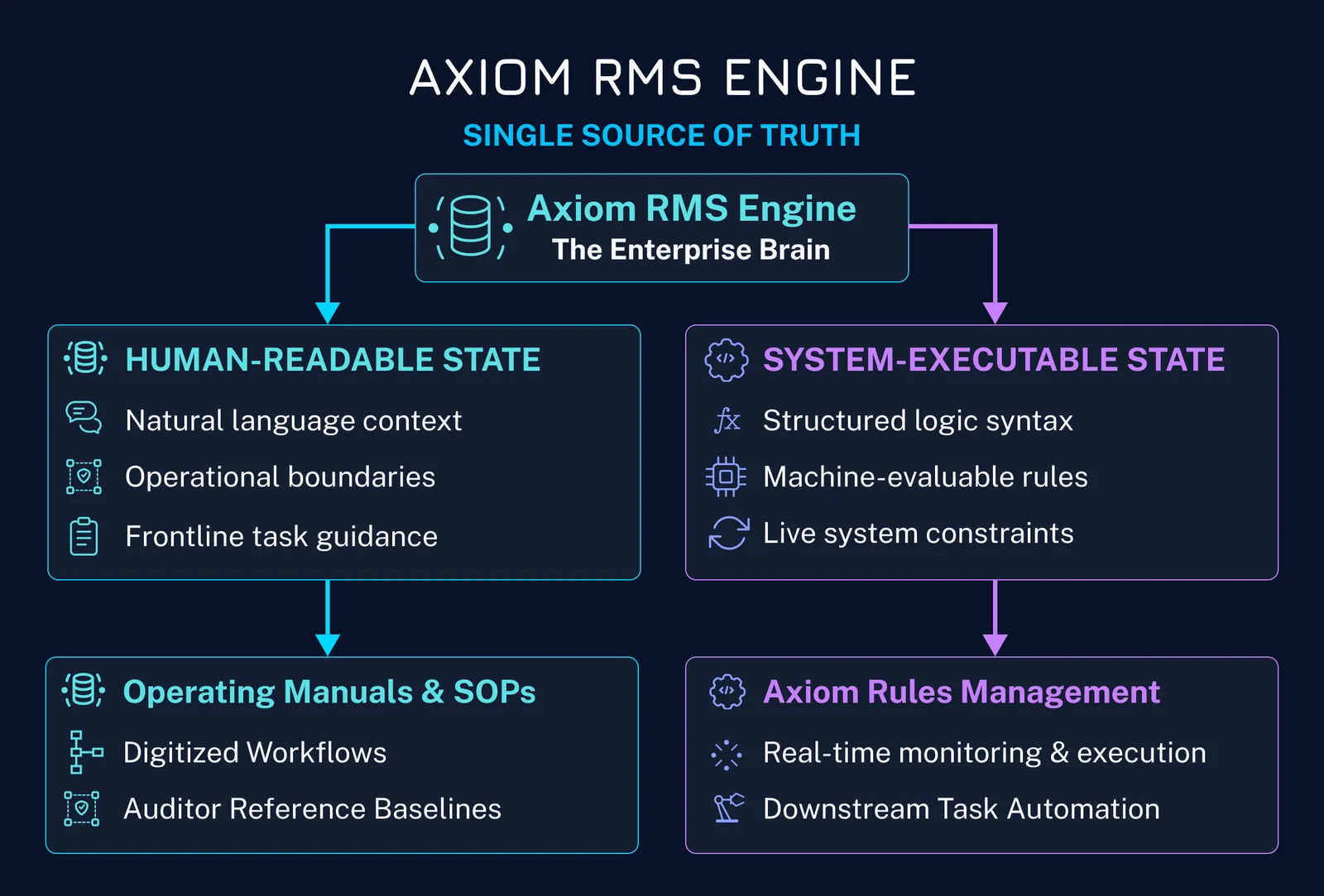
Traditional enterprise applications store requirements as static blocks of unstructured text. Axiom RMS changes this paradigm by maintaining every technical requirement simultaneously in two synchronized states:
1. The Human-Readable State
This state preserves natural language technical narratives for engineers, operations managers, inspectors, and third-party auditors. It outlines operational context, equipment classifications, hazard categories, engineering rationales, and clear procedural boundaries. It serves as the authoritative text for facility manuals, compliance filings, and contextual job aids.
2. The System-Executable State
Concurrently, the RMS encodes the requirement into structured, machine-readable logic. This format captures parameters, conditional dependencies, logical operators, and numerical boundaries in executable rule syntax. Automated engines can parse and enforce these rules without manual programming.
This dual-state architecture transforms operational governance. When an engineering standard is approved, its human-readable narrative populates mobile operating procedures and job aids, while its executable counterpart deploys into the Axiom Rules Management System.
From there, logic constraints flow into execution platforms—such as Fulcrum, DARTECH's operational execution engine—and existing enterprise asset management platforms. Constraints, safety parameters, and inspection intervals apply directly to operational systems. Manual transcription is eliminated, removing logic lag and operational drift.
3. The 4-Stage AI Quality Assurance Pipeline: Enforcing "Garbage In, Zero Out"
Engineering standards are authored across diverse operational units over decades, resulting in inconsistent phrasing, ambiguous limits, and conflicting requirements. In high-consequence environments, deploying AI without structured operational context magnifies these issues. An uncurated Large Language Model querying static databases and legacy PDFs will ingest outdated specifications, hallucinate contradictory advice, and expose operations to safety risks.
Axiom RMS enforces data governance through its core principle: "Garbage In, Zero Out". Before any new or amended requirement reaches human review or operational release, it must clear four automated quality gates:
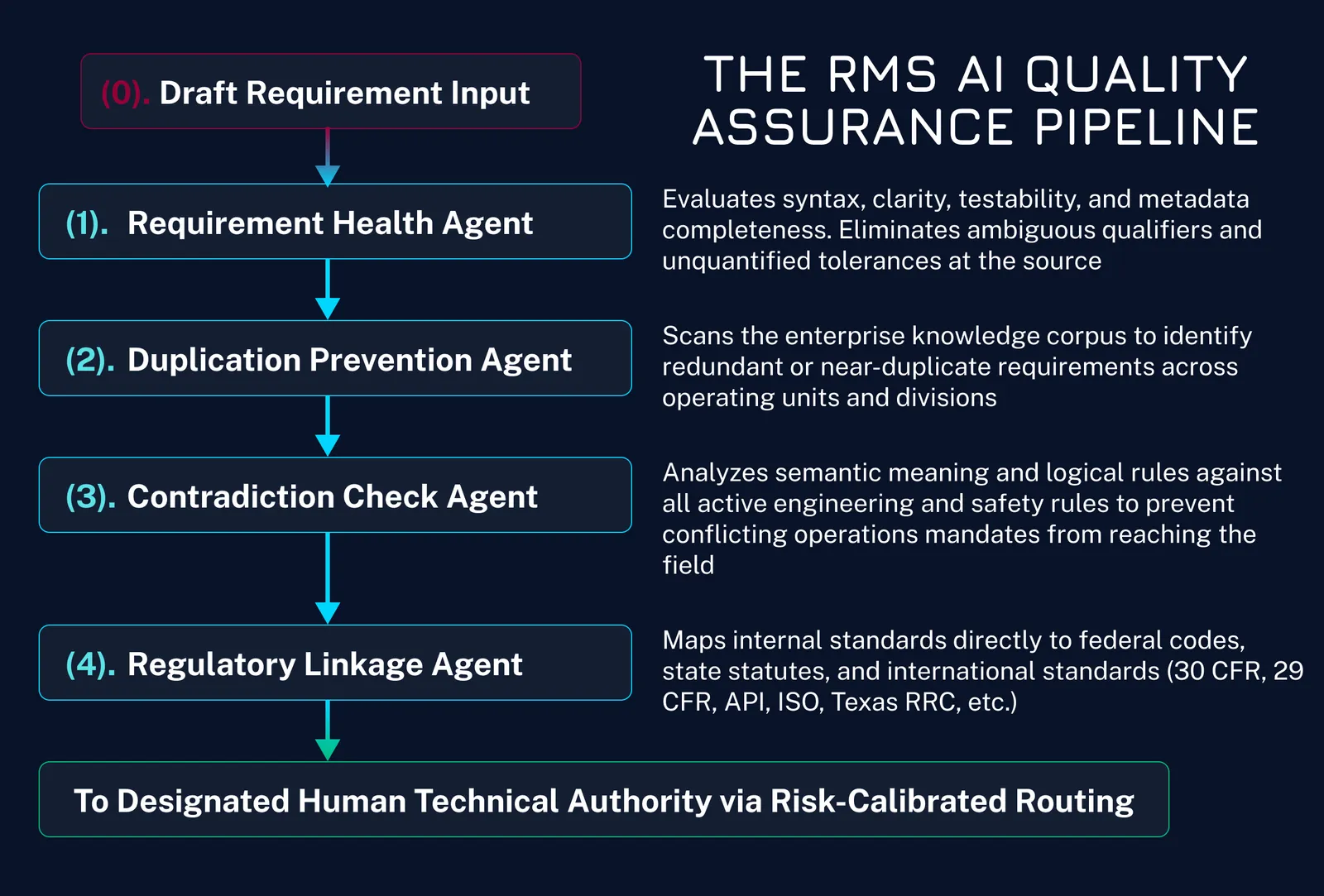
Stage 1: Requirement Health Evaluation
The Health Agent evaluates the structural, linguistic, and syntactic quality of the draft text. Operational standards must be measurable, unambiguous, and testable. The agent screens for:
- Subjective terminology ("adequate pressure," "regular inspection," "appropriate torque") and prompts the author for more precise language.
- Passive phrasing that obscures operational responsibility.
- Missing metadata requirements, including asset classes, operating contexts, and discipline tags.
Stage 2: Duplication Prevention
In large enterprises, different operating assets frequently generate redundant requirements for identical operating conditions. The Duplication Prevention Agent conducts semantic vector comparisons across the enterprise repository. If an engineering team drafts a standard that duplicates an active corporate specification, the system flags the overlap. This curbs specification bloat and standardizes operations across business units.
Stage 3: Semantic Contradiction Checking
The Contradiction Agent analyzes draft requirement logic against active operational and HSE rules. For example, if a piping engineering team specifies an operating envelope of up to 450 psi on a header, while an active process safety standard mandates a pressure trip at 420 psi, the agent flags this contradiction. By identifying logical conflicts during authoring, the RMS prevents contradictory mandates from reaching frontline operations.
Stage 4: Multi-Jurisdictional Regulatory Linkage
The Regulatory Linkage Agent reviews statutory codes, federal and state legal registries, and industry guidelines (including 30 CFR, 29 CFR, API, ISO, Texas RRC, and CalGEM). It suggests direct connections between internal requirements and governing legal authorities. This ensures every internal requirement maintains regulatory lineage, eliminating compliance blind spots.
4. Multi-Jurisdictional Traceability and the Relational Knowledge Graph
Operating complex industrial facilities requires managing overlapping layers of statutory authority. An offshore production facility in the Gulf of Mexico operates under the concurrent oversight of BSEE, the U.S. Coast Guard, the EPA, and OSHA, alongside voluntary API recommended practices (such as API RP 14C or API RP 54). Onshore shale operators balance federal Bureau of Land Management (BLM) regulations with state mandates from the Texas Railroad Commission (RRC) or California CalGEM.
Static database tables and spreadsheets struggle to model these interconnected relationships. When a statutory authority amends a clause, determining which internal specifications, facilities, and procedures are affected requires an exhaustive manual audit.
The Axiom RMS replaces static records with a relational operational knowledge graph.
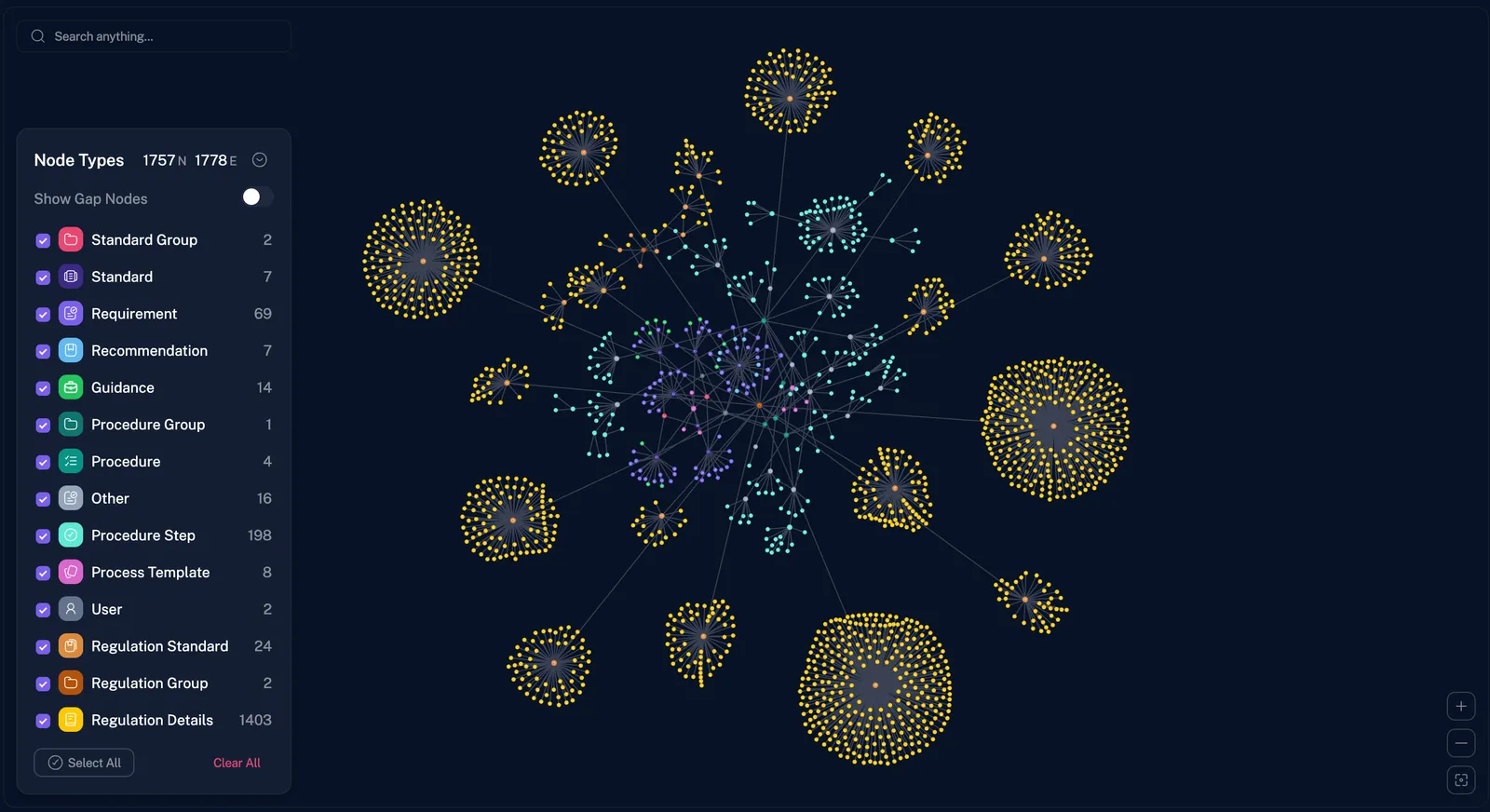
This graph architecture provides bi-directional traceability:
- Top-Down Traceability: When a regulatory body revises a rule (such as an amendment to 30 CFR or a Texas RRC order), compliance teams select the regulation to instantly view every linked internal requirement, designated Technical Authority, and active field execution task in Fulcrum.
- Bottom-Up Traceability: When a field technician conducts an inspection in Fulcrum, they can view the governing internal requirement, its approval timestamp, and the external statutory mandates requiring the task.
Operational Impact: During compliance audits, this relational structure reduces preparation labor by up to 70%. Rather than assigning engineers to locate documents over several weeks, compliance teams generate auditable compliance chains in minutes.
5. Enterprise Governance: Ownership, Risk-Calibrated Approvals, and the 2-Year Refresher Timer
Software should enforce operational accountability rather than obscure it. In the Axiom RMS, every requirement is linked to an accountable role—a designated Technical Authority who oversees its operational accuracy. A requirement cannot exist in the system without an accountable owner, nor can it reach production without passing human review.
Risk-Calibrated Routing via the Template Management System
Operational standards vary significantly in criticality. Standardizing a handrail coating specification carries far less operational risk than defining downhole well-control barriers or setting toxic gas detector thresholds.
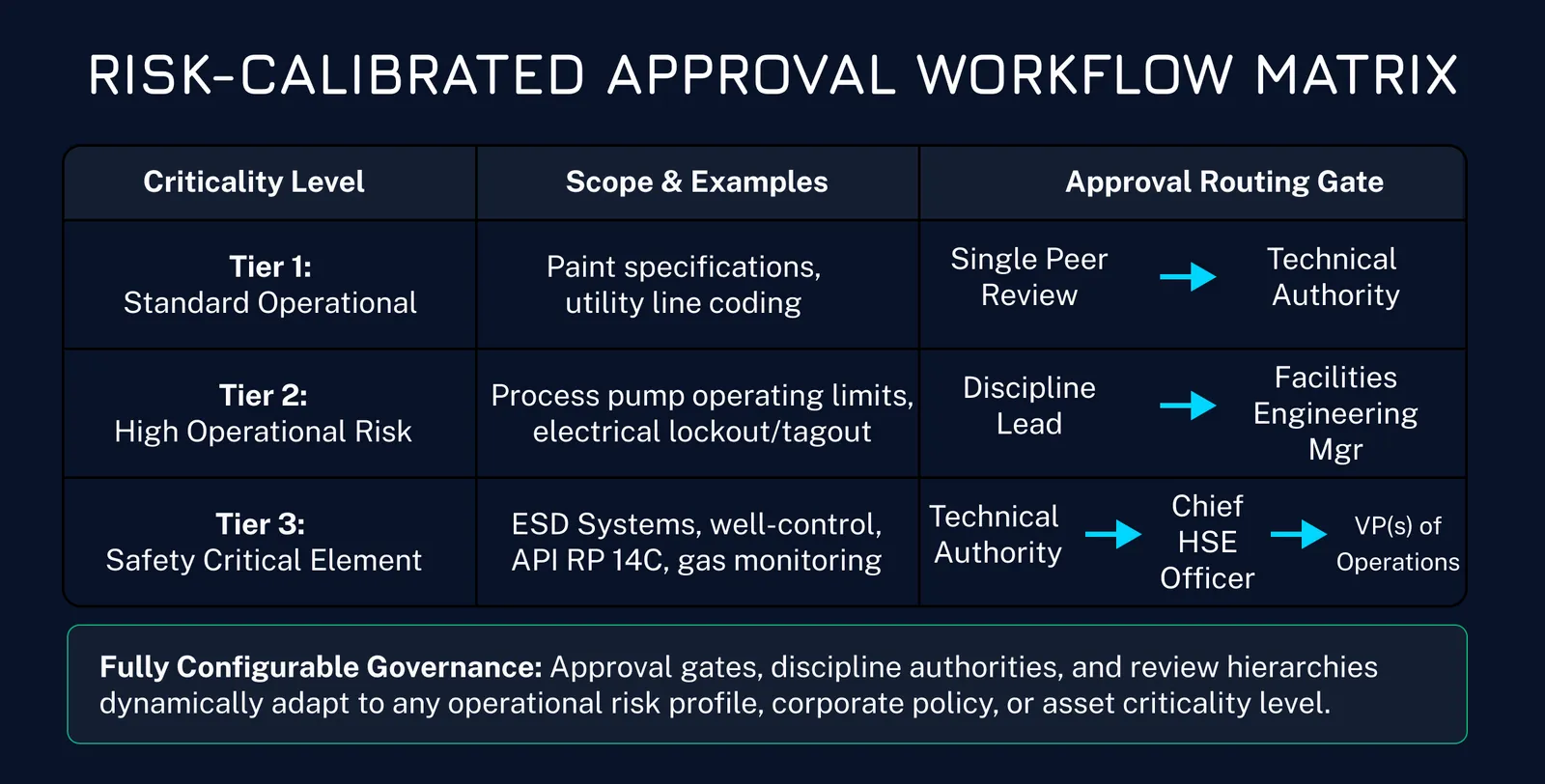
The RMS uses a configurable Template Management System to route approvals based on operational risk profiles:
- Tier 1: Standard Operational — Non-hazardous guidelines (e.g., paint specifications, utility line coding) follow an agile single-peer review routed to the designated Technical Authority, minimizing administrative drag for routine technical documentation.
- Tier 2: High Operational Risk — Complex operational boundaries (e.g., process pump operating limits, electrical lockout/tagout procedures) require cross-functional technical verification routed from the Discipline Lead to the Facilities Engineering Manager.
- Tier 3: Safety Critical Elements (SCE) — High-consequence operational mandates (e.g., emergency shutdown [ESD] logic, downhole well-control barriers, API RP 14C instrumentation, toxic gas monitoring) automatically enforce multi-tier governance gates: Technical Authority → Chief HSE Officer → VP(s) of Operations.
Every review, markup, comment, rejection, and sign-off is preserved in an immutable audit ledger. This ensures decisions are auditable during regulatory reviews and Management of Change (MOC) cycles.
The 2-Year Refresher Timer: Preventing Institutional Obsolescence
Industrial enterprises frequently face the issue of "set-and-forget" governance. Standards drafted during facility commissioning or after an incident can sit untouched in databases for years while equipment ages, operational realities change, and regulatory baselines shift.
To eliminate this operational risk, Axiom RMS enforces a configurable, automated two-year lifecycle timer on every active requirement.
6. Closing the Execution Loop: Synchronizing Axiom, Fulcrum, and Lessons Learned
An engineering standard is only as effective as its execution in the field. A requirement that sits isolated in a static database or an unread PDF does not improve operations.
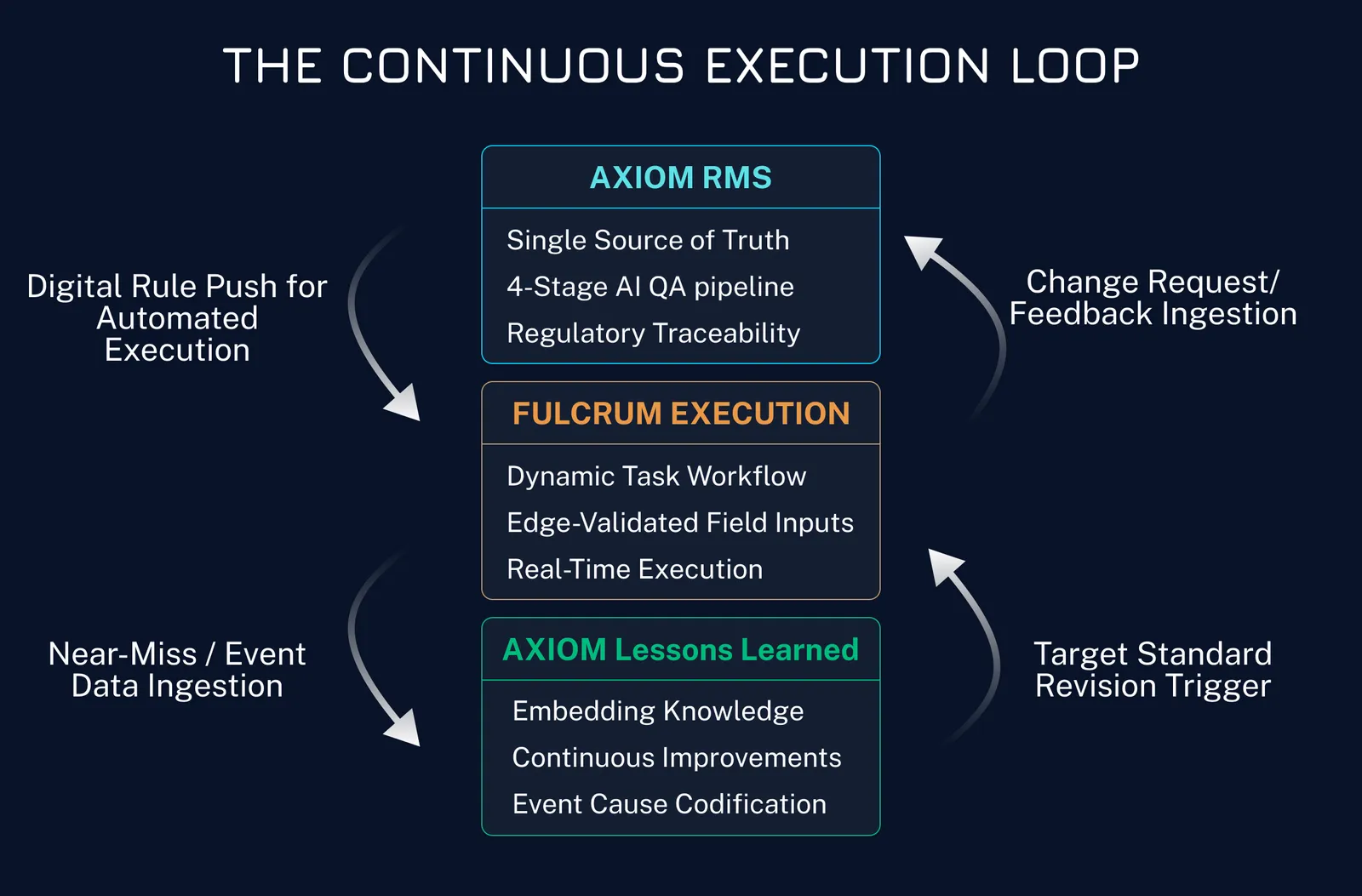
DARTECH bridges the divide between engineering intent and field operations by integrating the Axiom intelligence foundation with the Fulcrum execution engine.
Direct Field Synchronization
When an updated standard is approved in Axiom RMS, it updates downstream execution workflows automatically. Fulcrum pushes the revised task templates, operating checklists, and validation boundaries to frontline teams.
Field personnel do not need to print new paperwork, cross-reference revision notices, or log into desktop portals. The system interfaces they use to run checklists, sign permits, and verify isolations reflect the approved engineering baseline automatically.
Closed-Loop Field Feedback
Field realities sometimes conflict with engineering assumptions. When a crew discovers that a physical valve orientation or piping modification prevents compliance with a written clearance standard, manual workarounds often follow.
Axiom and Fulcrum institutionalize this field communication:
- The field technician submits a structured Change Request directly within the Fulcrum interface.
- The submission automatically attaches relevant equipment IDs, photos, and field notes directly to the requirement record in Axiom RMS.
- The designated Technical Authority receives an alert with operational context, allowing engineering to evaluate, adjust, and re-issue the standard through official governance channels.
Incident Codification via the Lessons Learned Loop
A critical challenge in operational governance is preventing the recurrence of known issues. When an equipment failure, near-miss, or procedural deviation occurs, enterprises typically conduct an investigation, publish an incident report, and file it away—leaving the underlying standard unchanged.
Axiom RMS integrates directly with the Axiom Lessons Learned System to resolve this disconnect:
- When an investigation identifies a root cause tied to an operational standard, the system flags the governing requirement in the RMS.
- An automated revision request routes to the designated Technical Authority, initiating an update cycle.
- The revised requirement passes through the four-stage AI QA pipeline, secures sign-off via the Template Management System, and deploys to Fulcrum.
This integration connects retrospective incident analysis to active field execution, helping prevent repeat safety incidents.
7. Strategic Business Drivers: The Enterprise ROI of Axiom RMS
Modernizing requirements management is an investment in capital discipline, operational efficiency, and risk reduction. For leadership across operations, engineering, and finance, deploying Axiom RMS delivers clear returns across five key operational drivers:
1. Capital Project Efficiency & Scope Control
- The Operational Problem: On major capital facilities, conflicting engineering disciplines, outdated specification sheets, and uncoordinated scope modifications drive 10% to 15% in project cost overruns.
- The RMS Solution: A centralized, version-controlled baseline ensures EPC contractors, fabricators, and engineering teams work against unified requirements. Built-in AI contradiction and duplication checking identifies cross-discipline discrepancies prior to fabrication.
- Enterprise ROI: Targets a 25% to 40% reduction in Engineering Change Orders (ECOs) and a 15% reduction in project commissioning delays.
2. Operational Safety and TRIR Reduction
- The Operational Problem: Procedural drift and decoupled safety protocols during maintenance and turnaround activities directly elevate the Total Recordable Incident Rate (TRIR).
- The RMS Solution: Approved safety constraints (including API RP 14C and 54 mandates) feed directly into the execution templates in Fulcrum, preventing unauthorized field bypasses.
- Enterprise ROI: Provides 100% verification of Safety Critical Elements (SCE) and automated compliance reporting for internal and external safety reviews.
3. Multi-Jurisdictional Audit Readiness
- The Operational Problem: Proving compliance across overlapping regulatory authorities (BSEE, OSHA, EPA, Texas RRC, CalGEM, API) requires weeks of manual document collection and spreadsheet cross-referencing.
- The RMS Solution: The relational operational knowledge graph provides bi-directional traceability from statutory clauses down to field sign-offs.
- Enterprise ROI: Cuts audit preparation labor by up to 70%, shortens regulatory response turnaround from weeks to minutes, and eliminates non-compliance findings caused by obsolete documentation.
4. Controlled AI Governance ("Garbage In, Zero Out")
- The Operational Problem: Unregulated generative AI tools querying disparate enterprise drives hallucinate answers using outdated standard sheets, exposing assets to operational risk.
- The RMS Solution: The four AI quality gates validate requirements for clarity, redundancy, contradiction, and statutory alignment before sign-off. Downstream enterprise AI models train and infer strictly against certified, approved baselines.
- Enterprise ROI: Prevents enterprise AI drift, provides defensible model inputs, and ensures automated workflows align with corporate risk thresholds.
5. Automated Operational Logic Deployment
- The Operational Problem: Manually translating engineering guidelines into code for control platforms, ERP logic, and maintenance schedulers introduces translation errors and delays Management of Change (MOC) lifecycles.
- The RMS Solution: The dual-state architecture simultaneously outputs human-readable guidelines and executable digital rules enforced by the Axiom Rules Management System.
- Enterprise ROI: Achieves 100% automation of operational constraint enforcement, accelerates MOC lead times, and eliminates manual transcription costs between engineering and IT.
8. Stakeholder Perspectives: Delivering Enterprise Alignment
Enterprise software investments must satisfy a multi-stakeholder buying committee. Each leadership discipline evaluates operational software through a distinct lens: risk, efficiency, usability, security, or compliance.
Here is how the Axiom Requirement Management System aligns those priorities:
For Executive Decision-Makers (CEOs, CFOs, COOs)
- The Perspective: Executives need confidence that modernization drives efficiency without increasing operational risk. They require defensible capital discipline and enterprise predictability.
- The Value: Axiom RMS helps prevent capital project overruns, protects operating margins, and establishes an auditable operational governance baseline. It transforms static institutional knowledge into a manageable enterprise asset.
For Operations Leaders (VPs of Operations, Plant Managers, Drilling Directors)
- The Perspective: Operations leadership focuses on throughput, uptime, and eliminating execution delays. They need frontline crews to execute work consistently without waiting on bureaucratic sign-offs.
- The Value: RMS removes procedural friction by pushing approved standards directly to field workflows via Fulcrum. Teams adapt quickly when operating conditions change, without bypassing safety parameters or generating non-productive time (NPT).
For Chief Engineers and Discipline Authorities
- The Perspective: Technical authorities want to eliminate the administrative burden of parsing documents and tracking spreadsheet revisions. They need certainty that their engineering intent is executed faithfully on the asset.
- The Value: RMS provides technical authorities with structured authoring workflows supported by automated AI quality checks. It flags contradictions before release, maintains an immutable history of revisions, and provides visibility into field compliance metrics.
For Digital Transformation and IT Leaders (CIOs, CDOs, VP of Architecture)
- The Perspective: IT leaders face mounting application sprawl, brittle custom integrations, shadow AI tools, and uncurated data lakes. They need unified systems that consolidate workflows and integrate cleanly with existing infrastructure.
- The Value: RMS replaces disconnected point solutions by structuring operational requirements at the foundation. Built on secure enterprise cloud architecture with corporate Single Sign-On (SSO) integration, zero-loss disaster recovery, and open APIs, it provides the clean data context required to power enterprise AI models safely.
For HSE and Compliance Directors
- The Perspective: HSE teams require procedural discipline, continuous compliance, and auditable verification. They must ensure that safety mandates are consistently followed across shifts.
- The Value: RMS ensures that safety rules cannot be uncoupled from field tasks. Through the Lessons Learned feedback loop, incident findings are codified directly into revised engineering standards, preventing recurring issues and safeguarding TRIR.
9. The Cognitive Operating System: From Passive Records to Connected Execution
Operational complexity is an inescapable reality of modern heavy industry. Increasing regulatory scrutiny, aging assets, generational workforce turnover, and market volatility mean that legacy approaches—relying on static databases and disconnected PDFs—are no longer viable.
DARTECH was built to solve operational fragmentation at its foundation. By positioning Axiom as the Enterprise Brain, Fulcrum as the Execution Engine, and Stratagem as the Proactive Intelligence Engine, DARTECH delivers a comprehensive Cognitive Operating System for complex operations.
The Axiom Requirement Management System provides the operational foundation that makes this vision possible. By transforming static engineering standards into dual-state, executable rules, establishing an AI quality assurance pipeline, and linking standards directly to frontline work in Fulcrum, RMS bridges the gap between engineering intent and field execution.
Enterprises that continue to rely on static databases, manual transcriptions, and disconnected PDFs will continue to absorb the costs of capital rework, operational delays, and regulatory audit penalties. Organizations that transition to active, digitized operational governance will establish safer, more adaptive, and execution-ready operations.
Transform Operational Complexity into Intelligent Execution
Learn how the Axiom Requirement Management System can help your organization eliminate capital rework, automate regulatory compliance, and connect engineering standards to frontline operations.
- Schedule an Enterprise Technical Briefing: Discover how the Axiom dual-state architecture integrates with your existing ERP, EAM, and field mobility platforms.
- Request an Operational Architecture Assessment: Evaluate your active engineering baselines against our 4-Stage AI Quality Assurance Pipeline.
- Explore Axiom and the rest of our Cognitive Operating System.
References & Operational Benchmarks
Autodesk & FMI Corporation — Harnessing the Data Advantage in Construction
Global research benchmark quantifying that decisions made using "bad data"—inaccurate, incomplete, inaccessible, or obsolete project specifications—drive $88.6 billion in avoidable rework globally, accounting for 14% of all construction and capital rework.Ernst & Young (EY) Global Energy Megaprojects Study — EY: 64% of Oil & Gas Megaprojects Exceed Budgets, Totaling $500B in Overruns
Comprehensive empirical analysis of 365 global oil and gas megaprojects (upstream onshore/offshore, LNG, pipelines, and refining assets with budgets exceeding $1 billion). Highlights that 64% of projects face capital cost overruns and 73% suffer operational schedule delays, largely attributable to front-end engineering design (FEED) divergence, uncontrolled scope creep, and fragmented specifications.International Association of Oil & Gas Producers (IOGP) / CFIHOS — CFIHOS Explained: Standardizing Information Handover
Capital facility data standardization study documenting that operations and maintenance (O&M) engineers across downstream and offshore operating assets spend up to 40% of their billable hours locating, validating, and reconciling mismatched as-built data, conflicting technical specification sheets, and static documentation repositories.